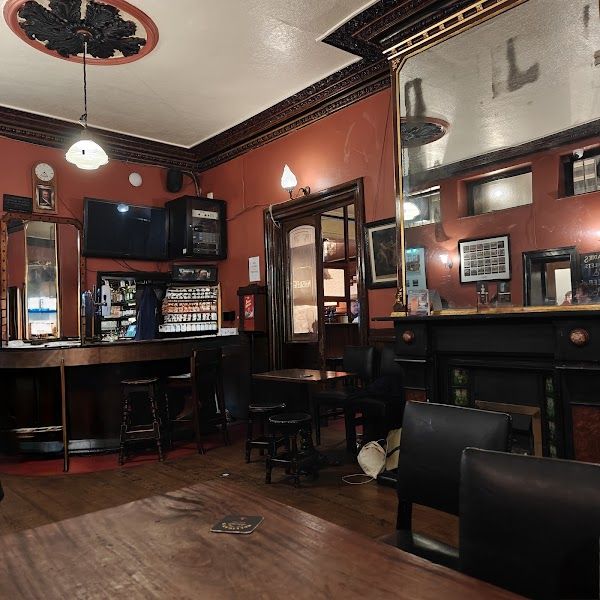
Grogan's Castle Lounge is the platonic after-work pub. There is no music and no television; there are walls hung with paintings by local artists, a room full of people who came to talk, a properly poured pint of Guinness, and a toasted ham-and-cheese sandwich that has become a small Dublin legend. You can walk in alone, be folded into a conversation within minutes, and leave having spent very little. That is the whole after-work promise, delivered better here than almost anywhere in the world.
Grogan's stands at 15 South William Street, in the sliver of Dublin 2 now marketed as the Creative Quarter, a short walk off Grafton Street, near Castle Market and the Powerscourt Townhouse, just north of St Stephen's Green. (For the record, the pub is on South William Street, not South Great George's Street, a mix-up that follows it around online.) There has been a pub trading on the spot since 1899, but the Grogan's that people mean today was made in the early 1970s, and to understand it you have to follow a barman across the city.
The pub that a barman built
In 1972, Tommy Smith and his business partner Paddy Kennedy bought the pub from its retiring proprietor, Joe Grogan. South William Street at the time was, as one obituary put it, "a somewhat desultory backwater," a centre of Dublin's rag trade and antiques dealers. The same year, McDaid's of Harry Street, long the headquarters of literary Dublin, was sold, and its revered barman, Paddy O'Brien, who had pulled pints there since 1937, was out of a job. Smith offered him a place behind the bar at Grogan's, and O'Brien's devoted clientele of writers, painters and talkers followed him across the city. The artist Robert Ballagh later described them trailing "their favourite barman to South William Street 'like a flock of seagulls following a trawler.'" O'Brien worked the Grogan's bar until the day before he died in 1989.
It is worth being precise about the literary mythology, because a lot of loose copy gets it wrong. The giants most often invoked, Patrick Kavanagh, Brendan Behan, Flann O'Brien, belong to the McDaid's era, and all three had died by the late 1960s, before Grogan's golden age began. They were not Grogan's regulars. What Grogan's inherited, via Paddy O'Brien in 1972, was McDaid's mantle: the sense of a pub as the natural habitat of the arts. Its own verified regulars are a distinguished list in their own right, the novelist Liam O'Flaherty, the critic and poet Anthony Cronin, the poets Michael Hartnett, John Jordan, Paula Meehan, Pat Boran and Theo Dorgan, and Brendan Behan's mother Kathleen among them. Boran has written that "it was in this setting that I first began to think of myself as a poet"; Meehan called Grogan's "a home from home… a post restante where letters, messages, books, manuscripts were sent and collected." An Irish Times writer summed the place up perfectly as "a vibrant arts centre and gallery disguised as a pub."
A gallery that happens to serve stout
That "gallery" description is not a figure of speech. Grogan's walls are covered, floor to ceiling, in original paintings by Irish artists, and nearly all of them are for sale. Crucially, the pub takes no commission: when a painting sells, every cent goes to the artist. Tommy Smith and Paddy Kennedy never charged a penny to hang work, which made the pub, in the words of Smith's obituary,"an absolute boon for younger artists especially." The tradition began in the 1980s, when a Limerick artist and friend of Smith's hung the first canvas, and grew into an annual show held on the first Sunday of December that has now run for more than three decades. Smith, a genuine patron of the arts who served on the board of Poetry Ireland, would quietly buy paintings himself to slip a hard-up artist a few pounds. After his death in February 2020, an artist catalogued more than 750 uncollected works dating back to the 1980s, a small measure of how many careers passed through the room.
Today the pub is still run by the same two families who have held it since the early 1970s. Smith's son Donal is a co-owner, and his grandson Daniel, the third generation of the family to work there, is a senior barman. Continuity runs through the staff as well: the long-serving barman Sean Kearney worked at Grogan's for fifty-three years, having already been behind the bar when Smith and Kennedy bought the place, until his death in 2024.
No music, no television, on purpose
The single decision that defines the Grogan's experience is a negative one: there is no television and no piped music. As Visit Dublin puts it, it is "one of the few bars left where your conversation need not compete with a wide screen TV or stereo." Daniel Smith has called the policy "the best thing we ever did, to not do it," explaining simply that "there's no TV and no music, so you just have to talk to the people beside you." The effect is exactly what an after-work pub should aim for: a room tuned entirely to conversation. The décor is unfussy and a little scuffed, wood panelling, a patterned carpet, stained glass, a jumble of stools and tables, but it is welcoming to everyone, and the clientele mixes freely. On any given evening you will find, as one guide memorably observed, old men in tweed jackets with worn anthologies of Irish literature sitting a few feet from Trinity students splitting a gooey toastie. Grogan's was also, notably, one of the first pubs in Dublin to serve women full pints without fuss, at a time when many establishments would only bring a woman a half.
The toastie, the pint, and what to order
Grogan's food menu is, gloriously, almost nothing, and that is the point. The house institution is the toasted sandwich: Irish cheddar and traditional deli ham, pressed to order, available all day and into the night. It is deliberately simple, described by one Dublin writer as "wrapped in plastic. Old-school perfection," and it has been listed among the reasons never to leave Dublin. Order it with ham or without; order two if you are settling in. The drink to put beside it is a pint of Guinness, poured with the patience the pub is known for, Grogan's gets through a formidable number of kegs a week, though the bar also keeps Beamish, Murphy's, the occasional draught Harp, local craft options like O'Hara's, and, as the Irish Times noted, is as happy to make you a pot of tea as a pint of plain. This is not a cocktail bar and never pretends to be; the pleasure is the pint, the toastie and the talk.
A practical note that matters more than it should: Grogan's was a famously cash-only house for most of its life and only began accepting card payments in 2021, prompted by the pandemic. It now takes cards, and there is a cash machine on the premises, but it remains a place where a few euro in your pocket is never a bad idea. Prices are fair for the city centre and the "special", a pint and a toastie, has long been one of the better-value orders in Dublin.
A pub that gives its art back
The gallery tradition is worth dwelling on, because it says everything about how Grogan's operates. Over four decades the walls have accumulated an astonishing archive: after Tommy Smith's death, an artist catalogued more than 750 uncollected paintings dating back to the 1980s, a physical record of every artist the pub ever gave a wall to. The annual show each December remains the centrepiece, but the ethos runs all year: hang your work, keep every cent when it sells, and know that the landlord might quietly buy a canvas himself to tide you over. In October 2024 the pub turned that generosity outward, holding a special art auction that raised more than €8,000 for Our Lady's Hospice in Harold's Cross, where Smith had died. This is a pub that treats art not as decoration but as a community it belongs to.
Smith's own patronage extended well beyond the walls. He co-produced a poetry chapbook with Theo Dorgan, served on the board of Poetry Ireland, and was central to the campaign that rescued the childhood home of Patrick and Willie Pearse on Pearse Street, now a cultural institute. When he died in February 2020, the eulogy was given by the artist Robert Ballagh, a fitting detail for a publican whom one newspaper called "the most gallant bar owner in Dublin." His son Donal now co-owns the pub and his grandson Daniel works behind the bar, so the philosophy passes down intact rather than being sold off.
In print, on air and on screen
For a pub that refuses a television, Grogan's has an outsized cultural footprint. It has been the subject of a full episode of Donal Fallon's popular Dublin history podcast, and it recurs constantly in writing about the city's pub culture, celebrated by everyone from Visit Dublin to the Irish Times, which once ranked it among the hippest spots in town and described it, memorably, as "a vibrant arts centre and gallery disguised as a pub." Its toastie has been listed among the reasons never to leave Dublin. It has appeared on film, too, and in 2015 a viral moment saw the comedian Amy Schumer, the director Judd Apatow and the musician Glen Hansard filmed singing "The Auld Triangle" inside, the kind of unforced, music-breaks-out scene that could only happen in a room built for people rather than screens. None of this has changed the pub, which is precisely the point: the fame is a by-product of its consistency, not a thing it chases.
When to go
The pub opens from around half past ten in the morning, seven days a week, which means you can beat the crowds with a mid-morning cup of tea if you like, but its natural home is the after-work and early-evening hours, when the room and the pavement outside both fill up. Grogan's is renowned for its outdoor drinking and people-watching: the smoking area runs the length of the pedestrian laneway called Castle Market, and on a fine evening the crowd spills out onto the cobbles with pints in hand, making it one of the best spots in the city simply to sit and watch Dublin go by. It fills quickly and it is rare to find an empty seat at peak times, so an early arrival is wise. There is no need to book, this is a walk-in pub in the truest sense, but there is every reason to give yourself time, because nobody comes to Grogan's for one quick drink.
What makes it the number-two entry on our list, behind only Rio's Bar Urca, is that it does the fundamental job of an after-work bar with total conviction and zero gimmickry. It is sociable, unpretentious, central and consistent; it costs little; it rewards the solo drinker and the group equally; and it has been doing all of this, at the same pitch, for half a century. If you want to understand why Dublin pub culture is admired around the world, you could start and finish here. For more of the city, our Dublin after-work list and the wider Dublin bar guide pick up the thread.
What to order
- 01
Pint of Guinness
Poured with the patience the house is known for.
- 02
The ham-and-cheese toastie
Irish cheddar and deli ham, all day, the Grogan's institution.
- 03
A pint of Beamish or Murphy's
The alternative stout, for the curious.
- 04
A pot of tea
Yes, really, and served as gladly as a pint.
Sources: Visit Dublin; Irish Times, Tommy Smith obituary; Come Here To Me, Paddy O'Brien; Hot Press (2025). Address confirmed as 15 South William Street; the literary lineage is framed via McDaid's rather than claiming Kavanagh/Behan/Flann O'Brien as Grogan's regulars, all of whom died before its 1970s era.